 |

 |
 Looking out the window (ra-file, 663 kb) |
He was, perhaps, the greatest blues guitarist of his generation.Stevie Ray Vaughan, who died just 36 days short of his 36th birthday, played with
blistering, note-bending intensity, a gut-wrenching vibrato and tons of soul. His all-too
abbreviated legacy-five albums as a leader and a number of powerful sideman stints -
ended with a longoverdue collaboration with older brother Jimmie Lee Vaughan, on the
posthumously released Family Style. A well-balanced mixture of driving rock and
roll, smooth r&b, earthy funk and heartfelt blues, the album took SRV full circle,
back to his South Dallas days, paying tribute to the music the Vaughan boys listened to
and loved in the Sixties and Seventies. |
 |
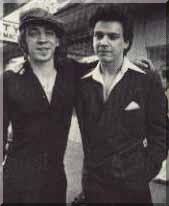 |
|
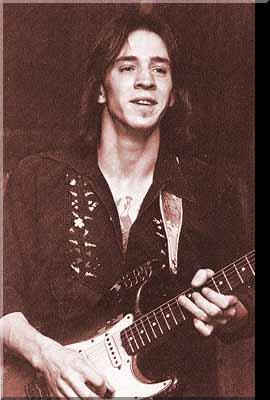 Stevie's first electric guitar - a gift from Jimmie - was a hollow-body
Gibson Messenger. From there he graduated to a '52 Fender Broadcaster another
hand-me-down from his older brother. By then, SRV had purchased his first record, a copy
of Lonnie Mack's instrumental hit. "Wham," which, alone with several Albert
King records, were the prime sources from which Stevie Ray shaped his own approach to the
instrument.
Stevie's first electric guitar - a gift from Jimmie - was a hollow-body
Gibson Messenger. From there he graduated to a '52 Fender Broadcaster another
hand-me-down from his older brother. By then, SRV had purchased his first record, a copy
of Lonnie Mack's instrumental hit. "Wham," which, alone with several Albert
King records, were the prime sources from which Stevie Ray shaped his own approach to the
instrument. 
|
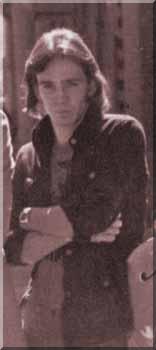 Jimmie played those "blues and originals"
in Storm, a gutsy trio that included future T-Birds bassist Keith Ferguson, and was soon
renowned in Austin for his guitar playing and comprehensive knowledge of blues and
r&b. Stevie dropped out of school and joined the exodus to Austin in the spring of
1972. Some time later he fell in with Crackerjack, which featured Johnny Winter's rhythm
section-drummer Uncle John Turner and bassist Tommy Shannon. That summer also marked the
first time he saw Albert King - who was to become his single biggest influence - perform
live.
Jimmie played those "blues and originals"
in Storm, a gutsy trio that included future T-Birds bassist Keith Ferguson, and was soon
renowned in Austin for his guitar playing and comprehensive knowledge of blues and
r&b. Stevie dropped out of school and joined the exodus to Austin in the spring of
1972. Some time later he fell in with Crackerjack, which featured Johnny Winter's rhythm
section-drummer Uncle John Turner and bassist Tommy Shannon. That summer also marked the
first time he saw Albert King - who was to become his single biggest influence - perform
live. 
Writer Brad Buchholz recalled that magical night at Antone's in his Dallas Morning
News tribute to SRV: "The skinny kid in hip-hugger bell-bottoms and downcast eyes
blew away gruff old Albert King that night. At one point, Mr. King stepped away from
Little Stevie and hid his guitar behind the stage curtains, as if to say, 'This little
kid is scaring my guitar." |

By 1973 Stevie had traded his '63 maple neck Strat for a '59 rosewood fingerboard
model, which remained his number one guitar for the rest of his career. (In a bizarrely
portentous accident, the neck of his beloved '59 was snapped in two pieces on July 9 of
this year, when a huge piece of scenery at the Garden State Arts Center in New Jersey
crashed onto a number of SRV's guitars.) Little Stevie left the Nightcrawlers at the end
of 1974, and became the second guitarist, along side Denny Freeman, with The Cobras. |
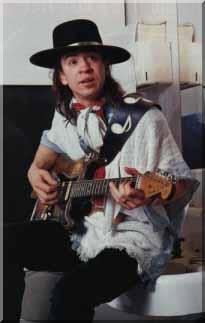
| "I was sitting in the audience at a little club downtown on Congress Avenue
called After Hours," recalls Austin guitarist Van Wilks. "I was checking out
Stevie with The Cobras. Then, all of a sudden, Stevie starts singing that Freddie King
song, 'Goin' Down,' and I nearly fell off my chair. Everybody knew he was a great guitar
player, but nobody had ever heard him sing before. Later, he developed his voice into a
phenomenal instrument, even though he remained kind of shy about it. Hendrix said he
didn't like his own voice, either, and I always felt he had an incredible singing voice.
I thought the same thing about Stevie. I mean, there was more to him than just playing
single notes on the guitar." |
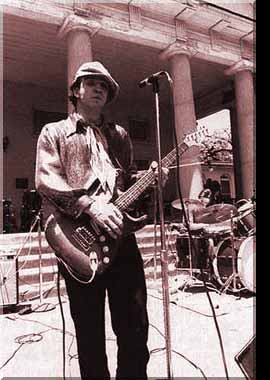 By the summer of 1977 Stevie had left The Cobras to form Triple
Threat Revue, a versatile outfit featuring Mike Kendrid (composer of "Cold
Shot") on piano, W.C. Clark on vocals and bass, Dallas drummer Freddie Pharaoh and
the fiery Fort Worth vocalist Lou Ann Barton, who left the T-Birds to join Stevie's new
band. What with Stevie's Hendrix covers, Lou Ann's torch ballads and Janis Joplin covers,
and W. C.'s Freddie King covers, the band was indeed a Triple Threat. Ultimately,
however, egos clashed. As the Austin American Statesman's blues maven Michael Point put
it, "Lou Ann... really wanted a guy to back her up on guitar, and not show her up
with guitar hero tricks. And Stevie wanted a backup vocalist, not a star. That tension
was often visible on stage."
By the summer of 1977 Stevie had left The Cobras to form Triple
Threat Revue, a versatile outfit featuring Mike Kendrid (composer of "Cold
Shot") on piano, W.C. Clark on vocals and bass, Dallas drummer Freddie Pharaoh and
the fiery Fort Worth vocalist Lou Ann Barton, who left the T-Birds to join Stevie's new
band. What with Stevie's Hendrix covers, Lou Ann's torch ballads and Janis Joplin covers,
and W. C.'s Freddie King covers, the band was indeed a Triple Threat. Ultimately,
however, egos clashed. As the Austin American Statesman's blues maven Michael Point put
it, "Lou Ann... really wanted a guy to back her up on guitar, and not show her up
with guitar hero tricks. And Stevie wanted a backup vocalist, not a star. That tension
was often visible on stage."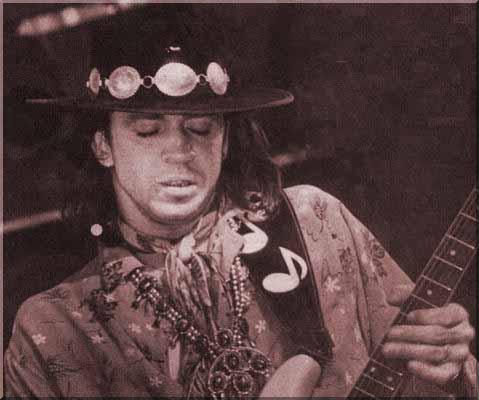
Word of Austin's hometown hero eventually reached the great r&b producer Jerry
Wexler, who flew to Texas in 1982 to catch Stevie Ray on his home turf. Considerably
impressed with the guitarist's talents, Wexler used his influence to place Double Trouble
on the bill at the 1982 Montreux Jazz Festival in Switzerland - a coup almost unheard of
for an unsigned act. Stevie Ray's stinging Strat licks were well-received by his European
audience. Particularly impressed by the Texan's fiery fretboard work was David Bowie.
After Double Trouble's set, Bowie met with Stevie Ray to raise the possibility of the
guitarist appearing on his next album. Bowie eventually hired Stevie Ray to play on
Let's Dance and appear on his 1983 world tour. |
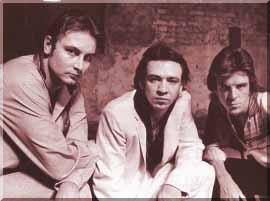
It wasn't long before opportunity came knocking once more on Stevie Ray's door.
Jackson Browne, a fan since his own encounter with Vaughan at the '82 Montreux Festival,
offered him the use of his Down Town studio, to record a demo that hopefully would land
Double Trouble a record contract. The taped results of Double Trouble's labors in
Browne's studio made their way to John Hammend Sr., the legendary talent scout and
producer, who counted Charlie Christian, Bob Dylan, Aretha Franklin and Bruce Springsteen
among his many discoveries. Excited by Stevie Ray's fresh take on an old formula, Hammond
purchased the demo and used his industry clout to secure a deal for Double Trouble with
Epic. |

While he was true to himself, he at the same time never failed to give credit
where it was due. In a 1988 interview, he noted: |
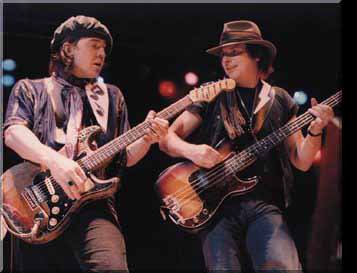 In 1984 Couldn't Stand The Weather was released, along
with a video - Stevie Ray's first - made for the title cut. The typically Texas-macho
clip received moderate airplay on MTV. This wider exposure helped push the album to
platinum and further cemented Stevie Ray's status as the reigning Texas Guitar King. As
he continued to forge his own identity on slightly-behind-the-beat Texas shuffles like
"Cold Shot" and "Honey Bee," he simultaneously pursued the ghost of
Jimi Hendrix, much to the delight of his young fans. If the connection was not apparent
from his version of Guitar Slim's "The Things That I Used To Do" (rendered as a
kind of response to Jimi's "Red House"), it became clear to one and all with
Stevie Ray's near-faithful rendition of "Voodoo Chile (Slight Return)," which
became a concert favorite.
In 1984 Couldn't Stand The Weather was released, along
with a video - Stevie Ray's first - made for the title cut. The typically Texas-macho
clip received moderate airplay on MTV. This wider exposure helped push the album to
platinum and further cemented Stevie Ray's status as the reigning Texas Guitar King. As
he continued to forge his own identity on slightly-behind-the-beat Texas shuffles like
"Cold Shot" and "Honey Bee," he simultaneously pursued the ghost of
Jimi Hendrix, much to the delight of his young fans. If the connection was not apparent
from his version of Guitar Slim's "The Things That I Used To Do" (rendered as a
kind of response to Jimi's "Red House"), it became clear to one and all with
Stevie Ray's near-faithful rendition of "Voodoo Chile (Slight Return)," which
became a concert favorite. 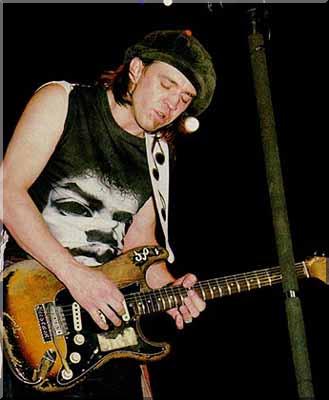
In some ways, he truly was that heir. "It just seemed like Hendrix was always
in his thoughts," said Austin guitarist Van Wilks. "He was certainly in his
heart and fingers. I remember one time we were talking about Hendrix - which is where our
conversations would always ultimately lead - and I pulled this Picture of Jimi's
tombstone from my wallet, which I'd taken when I was playing a gig in Seattle. I found
out that Jimi was buried in Renton, Washington, so I went there to pay my respects.
Anyway, when I showed Stevie Ray this picture, his eyes just got so wide - he couldn't
believe it. He just stood there and held that picture in his hand, and stared at it for a
long time." |

He returned to the United States a few days later. On October 17 he entered a
deter center in Marietta, Georgia, where he remained through November. Upon his release,
he returned to Dallas in an effort to escape the drugs, alcohol and late-night hanging
out that plagued him in Austin. |

© 1997-2008 www.corax.com - All rights reserved
Click here to help corax.com survive!